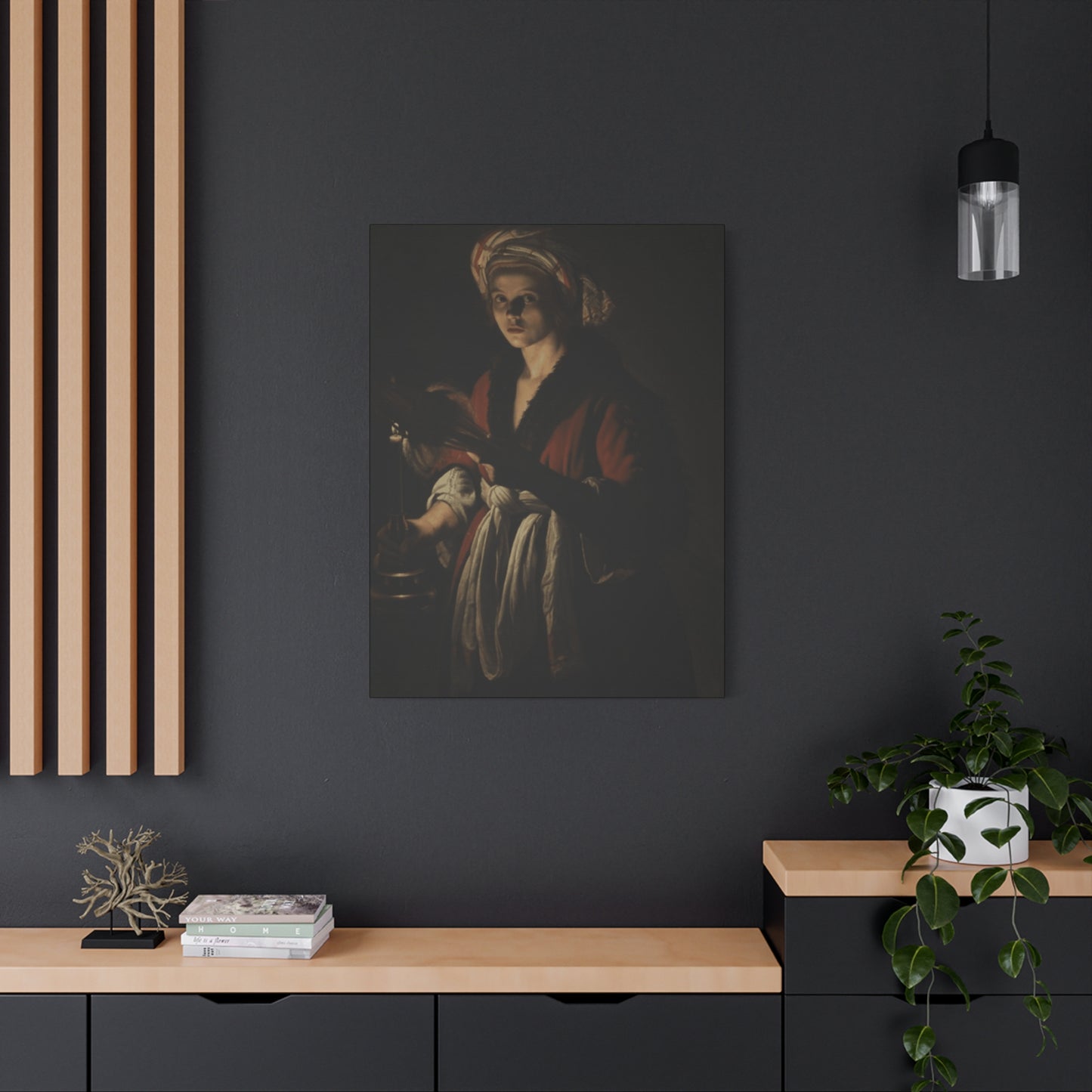


A Young Women Holding A Distaff Before A Lit Candle Wall Art & Canvas Prints
A Young Women Holding A Distaff Before A Lit Candle Wall Art & Canvas Prints
Couldn't load pickup availability
The Captivating Story Behind A Young Women Holding A Distaff Before A Lit Candle Wall Art: Exploring Symbolism, Artistic Merit, and Display Strategies for Your Living Space
The realm of classical artwork brings forth countless masterpieces that capture moments frozen in time, yet few possess the intimate warmth and symbolic depth found in pieces depicting domestic scenes from centuries past. A Young Women Holding A Distaff Before A Lit Candle Wall Art represents one such treasure that continues to mesmerize viewers with its delicate interplay of light, shadow, and human emotion. This particular artistic genre showcases the quiet dignity of labor, the contemplative nature of solitary work, and the ethereal quality of candlelight illuminating a subject engaged in the ancient craft of spinning thread.
When examining this captivating artwork, observers are immediately drawn into a world where time moves differently, where the flickering flame creates dancing shadows across textile fibers, and where a young woman's concentration reveals stories of patience, skill, and the rhythm of life before industrialization. The distaff, that wooden staff wrapped with unspun fibers, becomes more than a mere tool in these compositions—it transforms into a symbol of feminine virtue, industriousness, and the continuity of tradition passed down through generations.
The Profound Symbolism Embedded Within Fiber Arts Imagery
Throughout artistic traditions spanning continents and centuries, the depiction of women engaged in textile work carries layers of meaning that extend far beyond the surface representation. When artists chose to immortalize scenes of spinning, weaving, or thread-making, they tapped into a rich vocabulary of symbols that audiences of their era would immediately recognize and appreciate.
The distaff itself occupies a unique position in iconographic language. In ancient mythology, the Fates wielded this instrument to spin the threads of human destiny, creating an indelible association between fiber work and the very fabric of existence. When a painter depicts a young woman with this implement, they invoke these primordial connections, suggesting that even mundane domestic labor participates in cosmic patterns of creation and transformation.
The presence of candlelight in such compositions adds another dimension of significance. Fire represents knowledge, divine inspiration, and the human capacity to push back against darkness both literal and metaphorical. The juxtaposition of a working woman with a solitary flame suggests vigilance, dedication to craft regardless of the hour, and the inner light of consciousness that illuminates human endeavor. This combination creates a meditation on how work shapes identity and how focus can transform routine tasks into something approaching the sacred.
In many cultural contexts, spinning carried connotations of moral virtue and feminine excellence. Young women who mastered this skill demonstrated patience, attention to detail, and the ability to transform raw materials into something useful and beautiful—qualities highly prized in brides and household managers. Artists who captured these moments on canvas or panel were not simply recording a trade practice but celebrating an entire system of values centered around productivity, self-sufficiency, and the dignity of labor.
The Interplay of Light and Shadow in Candlelit Compositions
One of the most striking aspects of artwork depicting A Young Women Holding A Distaff Before A Lit Candle lies in the masterful handling of chiaroscuro—the dramatic contrast between illuminated and shadowed areas. Painters working in this tradition faced unique challenges in rendering the specific quality of light cast by a single flame, which differs markedly from daylight or even lamplight.
Candlelight possesses a warm, golden quality that flatters human skin tones while creating deep, mysterious shadows in areas untouched by its glow. This type of illumination requires exceptional skill to capture convincingly. Artists must observe how light behaves as it encounters different surfaces: the smooth skin of hands and face, the rough texture of unspun wool or flax, the polished wood of the distaff, and the fabric of clothing.
The flame itself presents particular difficulties. Its shape constantly shifts, and capturing its essence without making it appear static requires understanding the fundamental nature of combustion and light emission. Master painters developed techniques to suggest movement within stillness, using subtle gradations of yellow, orange, and white to convey the living quality of fire.
Beyond technical considerations, the selective illumination created by a single candle serves powerful narrative purposes. By choosing which elements to bathe in light and which to relegate to shadow, artists direct viewer attention and create mood. The young woman's face, typically turned toward her work, might be partially illuminated, revealing concentration in her expression while leaving other features mysterious. The distaff and the fibers being worked often catch the light prominently, emphasizing the centrality of the craft to the composition.
This careful orchestration of light creates intimacy. Viewers feel as though they're witnessing a private moment, perhaps peering through a doorway into a quiet room where a young woman works into the evening hours. The darkness surrounding the lit areas suggests the world beyond this small circle of productivity has receded, leaving only the essential elements: worker, tool, material, and light.
Examining Different Artistic Periods and Their Approach to Domestic Scenes
The tradition of depicting women at fiber work extends across numerous periods and regional styles, each bringing its own sensibility and emphasis to the subject matter. Understanding these variations enriches appreciation for any particular example of this genre, including pieces specifically showing A Young Women Holding A Distaff Before A Lit Candle Wall Art.
During the Dutch Golden Age of the seventeenth century, painters developed an extraordinary facility for rendering interior scenes illuminated by natural or artificial light. Artists like Gerrit Dou and Godfried Schalcken specialized in nocturnal scenes lit by candles or lamps, achieving levels of realism that still astonish viewers today. These painters belonged to a movement called the "Fijnschilders" or fine painters, who worked with minute brushes on small panels, building up layers of thin glazes to create luminous effects.
In Dutch domestic scenes, the presence of a woman engaged in textile work often carried moral overtones. These paintings appeared during a period when the newly prosperous merchant class sought artwork that reflected their values of industry, piety, and domestic virtue. A young woman spinning by candlelight embodied these ideals perfectly—she worked rather than idled, she pursued a worthy task rather than frivolous entertainment, and she remained at home rather than seeking public amusements.
French painters of the eighteenth century approached similar subjects with a different sensibility. Artists like Jean-Baptiste Greuze infused domestic scenes with sentiment and emotional expressiveness. Their young women might still hold distaffs and work by candlelight, but their faces revealed deeper feelings—melancholy, contemplation, or dreamy reverie. These paintings appealed to audiences who valued sensibilité, an eighteenth-century concept celebrating emotional sensitivity and moral feeling.
The Romantic period brought yet another shift in how artists portrayed such scenes. Painters of this era emphasized the poetic aspects of candlelit work, sometimes adding narrative elements or suggesting storytelling. The young woman with her distaff might be waiting for a lover's return, thinking of absent family members, or lost in imaginative worlds spun from the threads passing through her fingers.
As artistic movements evolved through the nineteenth century, some painters maintained interest in these traditional subjects even as others pursued more modern themes. Pre-Raphaelite artists in Britain, for instance, returned to medieval and early Renaissance sources, creating highly detailed paintings of women at textile work that combined historical accuracy with symbolic richness.
The Practical Craft: Understanding Distaff Use and Spinning Methods
To fully appreciate artwork depicting A Young Women Holding A Distaff Before A Lit Candle, it helps to understand the actual processes being represented. The distaff served as an essential tool in thread production for thousands of years, and its use required considerable skill developed through long practice.
The distaff is fundamentally a rod or staff, typically made of wood, around which prepared fibers are wound or wrapped. These fibers might be wool that has been washed, carded, and combed into an airy mass, or flax that has been processed through multiple stages to separate the plant fibers suitable for spinning. The spinner would tuck the base of the distaff under one arm or secure it at the waist, leaving both hands free for the actual spinning motion.
With the distaff holding the fiber supply in position, the spinner would draw out a few strands, giving them a twist to create the beginning of thread. This initial twisted section would be attached to a spindle—a weighted stick that hangs freely and rotates, adding twist to the fibers as it spins. The spinner's art lies in coordinating multiple simultaneous actions: drawing out fibers from the distaff at a consistent rate, maintaining the proper degree of twist by controlling the spindle's rotation, and winding finished thread onto the spindle shaft as it accumulates.
This process demands extraordinary hand-eye coordination and develops distinctive muscle memory. Experienced spinners work almost automatically, their hands performing the complex sequence of movements while their minds wander freely. This meditative quality of repetitive, skilled handwork explains why painters found the subject compelling—there's something profound about witnessing someone perform a task so thoroughly mastered that it becomes almost unconscious.
The quality of light matters significantly for this work. Natural daylight provides the best illumination for seeing the fibers clearly and detecting any irregularities in the developing thread. However, in pre-industrial societies where candles and lamp oil were expensive, working by artificial light signaled either urgent necessity or exceptional dedication. A young woman spinning by candlelight might be completing a commission, preparing materials for her marriage chest, or simply unable to let the day's tasks remain unfinished.
Different fiber types presented distinct challenges. Wool, with its natural crimp and relatively short staple length, requires frequent drafting—pulling out new fibers to join the thread. Flax fibers, which are much longer and smoother, must be kept slightly damp for easiest spinning and demand different hand positions. Artists who observed spinners carefully could indicate through subtle details which fiber type their subject worked with, adding another layer of specificity to their representations.
Color Palettes and Material Representation in Fiber Work Paintings
The color schemes employed in paintings of A Young Women Holding A Distaff Before A Lit Candle Wall Art play crucial roles in establishing mood, directing attention, and creating visual coherence. Artists working in this genre made deliberate choices about which hues to emphasize and how to orchestrate their interactions across the picture plane.
Candlelight naturally creates a warm color environment dominated by yellows, oranges, and golden browns. This warm illumination affects every visible surface, bathing the scene in tones that suggest coziness, intimacy, and comfort. Painters recognized that candlelight doesn't simply illuminate—it transforms colors, making cool blues appear greenish, intensifying reds toward orange, and giving whites a creamy or even golden cast.
The young woman's clothing provides opportunities for color interest within this constrained palette. Painters might dress her in rich browns, deep burgundies, or muted greens—colors that read well under warm illumination while suggesting modest prosperity. White or cream-colored elements like collars, cuffs, or caps catch the light dramatically, creating focal points and suggesting cleanliness and respectability.
The fibers on the distaff itself offer another chance for color variation. Wool might appear in natural shades ranging from white through gray to brown, while prepared flax takes on a silvery or pale golden tone. These natural fiber colors contrast with the deeper tones of the wooden distaff and the surrounding environment, helping the viewer understand the spatial relationships and material distinctions within the composition.
Background elements typically recede into shadow, rendered in deep browns, near-blacks, or very dark greens. This darkness serves multiple functions: it creates the dramatic contrast essential to candlelit scenes, suggests the late hour or enclosed nature of the workspace, and prevents distracting details from competing with the main subject. Occasionally, artists included barely visible elements in these shadows—a suggestion of a window, a piece of furniture, or a hanging textile—adding depth and context without compromising the composition's focus.
Some painters introduced cooler accent colors sparingly to prevent the warm candlelight palette from becoming monotonous. A touch of blue in a background element or a cooler gray in shadow areas helps balance the predominant warmth and adds visual sophistication. These cooler notes also serve to make the warm illuminated areas appear even warmer by contrast, enhancing the sense of the candle's glow.
The rendering of specific materials demonstrates painter virtuosity. Wood gains depth through subtle gradations from honey tones in the light to rich browns in shadow, with highlights suggesting polished surfaces. Fabric reveals its weave and drape through careful attention to how light catches on folds and wrinkles while shadow defines recessed areas. Skin requires the most delicate handling, with artists building up translucent layers to suggest its living quality and the blood beneath the surface that gives it warmth.
Compositional Strategies and Visual Flow in Domestic Workplace Scenes
Successful paintings of A Young Women Holding A Distaff Before A Lit Candle employ sophisticated compositional structures that guide viewer attention, create visual stability, and establish relationships between elements within the pictorial space. These organizational principles operate subtly but powerfully to make certain images particularly satisfying and memorable.
Many artists working in this genre adopted a pyramidal composition, with the seated woman's body forming a stable triangular shape that suggests permanence and balance. The apex of this pyramid might be the woman's head, inclined toward her work, while the base spreads across the width of her seated form. This geometric stability feels inherently satisfying to viewers and suggests the solid, enduring nature of the subject's labor.
The placement of the candle within the composition requires careful consideration. Positioned too centrally, it might dominate excessively and compete with the human subject for attention. Placed too peripherally, it fails to adequately explain the illumination scheme. Most successful examples position the candle slightly off-center, often at a level between the woman's hands and face, where it logically illuminates her work while remaining secondary to the human presence.
Artists create visual pathways that lead the viewer's eye through the composition in a deliberate sequence. Often, the viewer's gaze first catches the brightest illuminated area—perhaps the young woman's face or her hands working the fibers. From there, the eye might follow the length of the distaff upward or downward, trace the line of her arms, or move to the candle flame itself. These visual paths incorporate pauses where details invite closer inspection: the texture of the fibers, the expression of concentration, the quality of fabric or wood.
Diagonal lines add dynamism to compositions that might otherwise feel too static. The angle of the distaff, the tilt of the woman's head, or the direction of her gaze creates movement within the frame. These diagonals prevent the image from feeling rigid while maintaining overall stability through their careful balance.
Negative space—the empty or darkened areas around the main subject—plays an essential role despite containing little or no detail. These spaces allow the eye to rest, prevent visual clutter, and paradoxically make the lit, detailed areas feel more substantial through contrast. In candlelit scenes, negative space often consists of deep shadow that seems to extend indefinitely, suggesting that the small circle of light exists within a much larger darkness.
Some compositions include framing devices within the painting itself. A window opening might frame the young woman, or a doorway might create a literal frame around the illuminated scene. These internal frames create a sense of viewing someone in their private space, enhancing the intimacy and voyeuristic quality that makes such images compelling.
The format of the painting—whether vertical, horizontal, or square—influences compositional decisions. Vertical formats suit seated single figures, emphasizing the woman's form from head to lap where her hands work. Horizontal formats might include more environmental context or additional objects that expand the narrative. Square formats require particularly careful balancing to avoid feeling either cramped or too spacious.
The Role of Gesture and Body Language in Conveying Character
Within paintings of A Young Women Holding A Distaff Before A Lit Candle Wall Art, the subject's physical bearing and the specific positions of her hands, head, and body communicate rich information about her character, mood, and relationship to her work. Artists skilled in capturing these nuances create figures that feel psychologically present and emotionally accessible.
Hand positions reveal tremendous amounts about skill level and engagement with the task. Experienced spinners develop characteristic hand postures that differ markedly from those of beginners. The angle of the wrist, the precise grip on fiber, and the particular way fingers guide threads show mastery. Artists who observed spinners closely could indicate through these details whether their subject was a practiced expert or still learning the craft.
The tilt and position of the head suggest the young woman's mental state. A head bowed deeply toward the work indicates intense concentration, perhaps on a particularly challenging section where the fibers resist smooth drafting or where precision is especially important. A head held more upright, with eyes focused on the middle distance rather than directly on the hands, suggests work so habitual that conscious attention is minimal—the spinner's thoughts have drifted elsewhere while her hands continue their practiced movements.
Facial expressions range from serene contentment to furrowed concentration to dreamy abstraction. The particular expression chosen by the artist dramatically affects how viewers relate to the figure. A slight smile suggests satisfaction in work well done, while a more neutral or solemn expression might indicate dutiful completion of an assigned task. Some paintings show young women with slightly parted lips, as if they might be humming or singing while they work, adding an auditory dimension to the visual scene.
The overall posture of the body reveals comfort or discomfort with the task. A woman seated with shoulders relaxed and spine in a natural curve appears at ease with her work, settled into a position she can maintain for extended periods. Stiffness or tension in the shoulders might suggest fatigue, reluctance, or a worker less accustomed to long hours of this labor.
The relationship between the figure and the distaff itself communicates familiarity. Someone comfortable with the tool holds it confidently, positions it at exactly the right angle for efficient work, and demonstrates through subtle details of posture that the implement has become almost an extension of her body. Less experienced workers might grip the staff more tentatively or position it less optimally.
Some artists included subtle narrative details in body language. A young woman glancing toward a darkened window or doorway might be expecting someone's arrival or return. One whose attention seems divided between her work and something beyond the picture frame suggests a mind occupied with concerns beyond the immediate task.
The clothing the figure wears and how she wears it also communicates information. Neatly arranged garments with crisp white collar and cuffs suggest personal pride and self-respect. More disheveled dress might indicate work of such urgency that appearance became secondary. The presence or absence of jewelry, hair ornaments, or other decorative elements places the figure in a particular social stratum.
Preservation and Display Considerations for Antique and Reproduction Artwork
Those fortunate enough to own A Young Women Holding A Distaff Before A Lit Candle Wall Art, whether an antique original or a high-quality reproduction, bear responsibility for its proper care and thoughtful presentation. Understanding conservation principles and display best practices ensures these images can be appreciated by many generations.
For original paintings on canvas or wood panel from earlier centuries, environmental conditions prove critical to long-term survival. Temperature fluctuations cause materials to expand and contract at different rates, potentially creating cracks, delamination, or other structural damage. Ideally, such artwork should remain in spaces where temperature stays relatively constant, avoiding placement near heating vents, radiators, or air conditioning units that create localized temperature variations.
Humidity control matters equally. Excessive moisture can lead to mold growth, while extremely dry conditions cause wooden supports to shrink and crack. Canvas becomes slack in high humidity and brittle in low humidity. Museum standards suggest maintaining relative humidity between 45 and 55 percent, though slight variations within the 40 to 60 percent range are generally acceptable for most paintings.
Light exposure presents perhaps the greatest threat to painted artwork. Ultraviolet radiation causes pigments to fade and organic materials like oil binders and varnish layers to deteriorate. Natural daylight contains substantial UV radiation, as does unfiltered fluorescent lighting. Paintings should never be positioned where direct sunlight strikes them. When displaying valuable works, consider UV-filtering glazing for framed pieces, UV-filtering window treatments for rooms containing paintings, and LED lighting systems that produce minimal UV radiation.
Even with UV protection, total light exposure should be limited. Conservation guidelines suggest that sensitive materials should not receive more than 50 lux of illumination, though paintings in private homes typically experience higher levels. As a practical compromise, consider rotating artwork periodically to different locations, giving pieces "rest periods" in darker storage areas.
The surface of oil paintings requires particular care. Dust accumulates over time and can be gently removed with a very soft, clean brush—never by wiping or using cleaning products. Any cleaning beyond this basic dusting should be left to professional conservators, as improper cleaning can remove varnish layers or even original paint.
Hanging hardware and methods must provide secure support without damaging the artwork. For heavy pieces, use wall anchors rated for the specific weight, accounting for the painting, frame, and hanging hardware combined. The hanging wire or hardware should attach to the frame rather than the painting's support structure. Avoid hanging paintings on exterior walls in climates with extreme weather, as temperature and humidity fluctuations are most pronounced in these locations.
For reproduction prints of A Young Women Holding A Distaff Before A Lit Candle Wall Art, preservation concerns differ somewhat but remain important. Quality prints on archival paper or canvas can last many decades with proper care. Frame them using acid-free mats and backing boards to prevent deterioration. If glazing is used, ensure adequate space between the glass and the print surface—direct contact can cause problems over time.
Display positioning for reproductions still requires thought regarding light exposure, though these pieces can tolerate somewhat brighter conditions than fragile antique originals. Still, avoid direct sunlight and consider the long-term effects of sustained bright illumination.
Consider the surrounding décor when positioning such artwork. Paintings of domestic candlelit scenes often look most at home in quiet, intimate spaces—bedrooms, studies, libraries, or cozy corners of living spaces. The contemplative mood they create might feel incongruous in very modern, minimalist, or energetically decorated rooms, though thoughtful placement can make almost any combination work.
Incorporating Candlelit Domestic Scenes Into Contemporary Living Spaces
The question of how to successfully integrate imagery of A Young Women Holding A Distaff Before A Lit Candle Wall Art into modern homes deserves careful consideration. These paintings and prints carry aesthetic qualities and cultural associations from earlier eras, yet they can enhance contemporary interiors when displayed with sensitivity to both the artwork and the surrounding environment.
One successful approach involves creating deliberate contrast between the historic artwork and modern furnishings. A candlelit domestic scene in a traditional frame might hang above a sleek contemporary sofa, creating visual interest through the juxtaposition of different temporal aesthetics. This approach acknowledges the painting's origins while integrating it into current living patterns. The key is maintaining balance—the artwork should feel like a thoughtful choice rather than an awkward leftover from a different decorating scheme.
Another strategy emphasizes continuity and harmony. In rooms decorated with traditional or transitional furniture, these paintings feel naturally at home. Wood furniture with visible grain, textile elements like woven throws or needlework pillows, and warm lighting schemes create environments where images of young women at fiber work seem contextually appropriate. Here the artwork reinforces the overall aesthetic rather than contrasting with it.
Color coordination helps paintings integrate successfully into their surroundings. The warm tones typical of candlelit scenes—golds, browns, deep reds, and touches of cream or white—can be echoed in room furnishings, wall colors, or decorative accessories. This repetition of the painting's palette throughout the space creates visual unity and makes the artwork feel like an intentional part of the room's design rather than an afterthought.
Scale relationships matter significantly. A small painting can get lost on a large empty wall, while an oversized piece might overwhelm a small room. Consider the painting's dimensions in relation to the furniture around it and the wall space available. As a general guideline, artwork hung above a sofa or sideboard should span roughly two-thirds to three-quarters of the furniture's width, though creative violations of this rule can sometimes work beautifully.
Lighting the artwork appropriately enhances both its visibility and its impact. Since these paintings depict candlelight scenes, they often look particularly effective under warm-toned artificial lighting. Picture lights mounted directly on the frame or adjustable track lighting can highlight the painting while creating ambient illumination in the room. Avoid harsh, cool-white lighting that contradicts the painting's inherent warm tonality.
Grouping and arrangement possibilities include hanging the painting as a focal point in isolation or incorporating it into a gallery wall arrangement with other artwork. When creating groupings, consider how different pieces relate visually and thematically. A candlelit domestic scene might pair well with still life paintings, other genre scenes, or landscape works sharing similar tonal qualities.
The frame itself plays a crucial role in mediating between the artwork and its environment. Traditional gilded frames suit formal settings and emphasize the painting's historic character. Simpler wood frames in warm tones might feel more appropriate in casual spaces. Contemporary frames in black or silver can work when the goal is to emphasize contrast between old and new aesthetics.
Room function influences where such paintings make most sense. Bedrooms provide natural settings for contemplative scenes that reward quiet viewing. Studies and libraries suit images that suggest focus and concentrated work. Dining rooms have long traditions of displaying artwork, and the warm domestic character of these paintings can enhance the convivial atmosphere of shared meals.
Consider sightlines and viewing distances. Some paintings reward close examination of fine details—the texture of fiber, subtle expressions, or refined brushwork. These pieces work well in locations where viewers can approach closely. Other examples make their primary impact through overall composition and tonal harmonies, functioning effectively even when viewed from across a room.
The Narrative and Storytelling Potential Within Domestic Genre Paintings
While paintings of A Young Women Holding A Distaff Before A Lit Candle Wall Art might initially appear to depict simple, straightforward moments, careful examination reveals layers of narrative possibility embedded within these seemingly quiet scenes. Artists working in the genre painting tradition often incorporated storytelling elements that reward attentive viewing and invite imaginative engagement.
The most fundamental narrative level involves the immediate activity depicted—a young woman engaged in textile work by candlelight. Yet even this basic situation raises questions that prompt viewers to construct stories. Why does she work by artificial light? Has she continued labor into evening hours because the task is urgent or the deadline approaching? Does she work late out of necessity, perhaps because poverty requires every possible moment be devoted to productive labor? Or does she spin by choice, finding satisfaction in her craft and reluctant to set it aside even as darkness falls?
The woman's age and apparent social status contribute to narrative interpretation. A very young woman might be preparing materials for her marriage, working on items for her future household. Medieval and early modern customs often required brides to provide substantial quantities of spun thread and woven fabric as part of their marriage preparations. A painting depicting this situation might carry associations with anticipation, transition, and preparation for a new life phase.
Alternatively, the subject might be a servant or working-class woman spinning for wages or as part of household duties. This interpretation suggests a different narrative—one centered on labor obligations, economic necessity, and the daily rhythms of working life. The expression and bearing of the figure often provide clues about which interpretation feels most appropriate.
Some artists included subtle details that expand the narrative. A window showing darkness outside confirms the late hour. A door partially visible in the background raises questions about who might enter or what lies beyond this illuminated moment. Objects placed nearby—a basket, a stool, a piece of furniture—suggest the larger environment and daily life patterns surrounding this specific moment.
The painting's emotional tone significantly influences the stories viewers construct around it. A subject whose expression suggests contentment or peaceful absorption in her work invites different narratives than one whose face reveals fatigue, worry, or melancholy. Some paintings capture moments of dreamy abstraction, suggesting the spinner's thoughts have wandered to concerns, hopes, or memories far from her immediate task.
The candle itself can carry narrative significance beyond its practical function. A tall candle barely burned suggests the evening's work has just begun, while a guttering stub indicates hours of labor already completed. Some symbolically inclined viewers might read the candle as a metaphor for the young woman's own life—her youth and vigor represented by the flame, the inevitable passage toward darkness, the temporary nature of individual existence.
Fiber work itself provided rich metaphorical material for storytelling. The act of transforming raw, chaotic fibers into ordered thread resonated with broader themes of imposing order on disorder, creating value through effort, and the human capacity to shape raw materials into useful forms. Thread connected to destiny and fate through mythological associations, suggesting that even humble domestic labor participated in cosmic patterns.
Some narrative interpretations emphasize solitude and independence. A woman working alone demonstrates self-sufficiency and the capacity to be productively engaged without requiring social interaction or external entertainment. This reading celebrates self-reliance and inner resources.
Other interpretations might emphasize isolation or loneliness. The same solitary figure could represent someone separated from community, perhaps by circumstances, personality, or social position. The darkness surrounding the small lit area might suggest emotional isolation as much as physical darkness.
Historical context provides additional narrative dimensions. Viewers familiar with the period when the painting was created might recognize specific details that anchor the scene in particular social realities—the style of dress indicating class position, the type of fiber suggesting regional practices, or the overall composition echoing contemporary attitudes about gender, work, and virtue.
Acquiring Authentic Artwork and Quality Reproductions of Historical Subjects
For those drawn to imagery of A Young Women Holding A Distaff Before A Lit Candle Wall Art and wishing to add such pieces to their collections, understanding the market for both original historical paintings and high-quality reproductions enables informed decisions and appropriate expectations.
Original paintings from the seventeenth through nineteenth centuries that depict domestic candlelit scenes appear regularly in the art market, though prices vary enormously based on attribution, condition, provenance, size, and aesthetic quality. Works by recognized master painters command substantial prices, often reaching into hundreds of thousands or even millions of dollars at major auction houses. Lesser-known or anonymous artists from the same periods offer more accessible entry points, with smaller works by competent but not celebrated painters sometimes available for thousands rather than hundreds of thousands of dollars.
Condition significantly affects both price and suitability for display. Paintings that have survived centuries without major damage, harsh restoration, or significant darkening of varnish layers are increasingly rare and command premium prices. Works requiring restoration present opportunities for collectors willing to invest in conservation work, though restoration costs should be carefully considered when evaluating total expenditure.
Provenance—the documented history of ownership—adds considerable value to any artwork, both financial and scholarly. Paintings with continuous ownership records back to the artist's era are more securely datable and less likely to be misattributed. Those that have passed through respected collections gain additional prestige.
Authentication presents challenges with older works. Distinguishing originals from period copies, workshop productions, or later pastiches requires expertise. Serious collectors should work with reputable dealers, seek expert opinions, and consider technical analysis including infrared reflectography, x-radiography, or paint sampling when purchasing expensive works.
The auction market provides one avenue for acquiring historical paintings. Major houses like Sotheby's and Christie's offer the most celebrated works and provide extensive catalog information, though buyer's premiums add significantly to hammer prices. Regional auction houses may offer better value on less prominent works, though buyers need sufficient expertise to evaluate quality independently.
Dealers specializing in Old Master or nineteenth-century paintings offer another purchase pathway. Reputable dealers provide expertise, stand behind their attributions, and often guarantee authenticity. They may also offer payment plans or accept trades, providing flexibility unavailable through auctions.
For those whose interest lies in the imagery rather than owning historical artifacts, high-quality reproductions offer excellent alternatives. Reproduction methods have advanced dramatically, with giclée printing on canvas creating images that capture much of the original's visual impact at a tiny fraction of the cost.
When selecting reproductions, several quality factors deserve consideration. Resolution and file quality determine how much fine detail transfers from the original to the reproduction. The best reproductions are created from extremely high-resolution photographs or scans that capture every nuance of brushwork and surface texture.
The substrate—the material receiving the printed image—affects the final appearance significantly. Canvas reproduces the texture of the original support and can be stretched and displayed frameless or in minimal frames for a contemporary look. Fine art papers offer smooth surfaces that showcase color and tonal subtlety beautifully but typically require matting and glazing. Metal prints create striking modern presentations with unusual luminosity.
Color accuracy varies between reproduction methods and printers. The best reproduction services use color-managed workflows that ensure printed colors closely match the original artwork. Multiple rounds of proofing and adjustment may be necessary to achieve optimal results.
Size options with reproductions allow flexibility impossible with originals. Images can be scaled larger or smaller to suit available display space, though maintaining the original's proportions usually produces the most satisfying results. Extreme enlargement may reveal limitations in the source image resolution.
Several online sources specialize in art reproductions, ranging from general retailers to specialist services focusing on museum-quality prints. Museum shops, including online stores, often offer reproductions of works in their permanent collections, providing reliable attribution information and supporting worthy institutions.
Licensing and copyright issues require attention when reproducing artwork. Most paintings created before the twentieth century have entered the public domain, meaning their images can be freely reproduced. However, photographs of these paintings may carry copyright protection. Museums and archives sometimes restrict reproduction rights or charge licensing fees, particularly for commercial use.
Some collectors commission hand-painted copies of historical works. Skilled copyists can recreate paintings with impressive fidelity, though the cost of hand reproduction approaches or exceeds that of minor original works. These copies occupy an interesting position—they're clearly not the historical artifacts but possess craftsmanship and uniqueness lacking in mechanical reproductions.
Conclusion
Paintings depicting A Young Women Holding A Distaff Before A Lit Candle Wall Art participated in broader cultural conversations about femininity, virtue, and women's proper roles within society. Examining these works through the lens of gender studies reveals how seemingly neutral representations of everyday activities actually reinforced specific ideologies about women's nature and appropriate behavior.
Throughout much of European history, spinning and other textile crafts carried strong associations with feminine virtue. The concept of the "virtuous woman" described in Proverbs 31 emphasizes her skill at textile work: "She seeks wool and flax, and works with willing hands... She puts her hands to the distaff, and her hands hold the spindle." This biblical passage enshrined fiber work as spiritually meritorious labor for women, creating religious sanction for an economic necessity.
The association between textile work and feminine sexuality operated on multiple levels. In some cultural contexts, successful spinning demonstrated that a young woman possessed the patience, fine motor skills, and attention to detail necessary for household management—qualities that made her a desirable marriage partner. Spinning competitions or "spinning bees" provided supervised social contexts where young women could meet potential suitors while demonstrating their domestic competence.
Conversely, fiber work kept young women occupied in productive labor, reducing time available for potentially problematic activities. An industrious spinner remained at home rather than seeking entertainment or social interaction in public spaces where her virtue might be compromised. The association between idleness and moral danger made busy hands a sign of moral as well as economic worth.
The solitary nature of spinning as typically depicted in these paintings reinforces particular ideals of femininity. The young woman works alone, focused on her task, demonstrating self-sufficiency within appropriate bounds. She neither requires nor seeks external stimulation, finding satisfaction in productive labor. This model of self-contained, home-centered female existence supported patriarchal social structures that benefited from women's unpaid or low-paid domestic labor.
Yet some scholars identify potential subversive elements within these representations. A woman absorbed in skilled work, producing thread that will eventually become cloth and garments, participates in economic production. Her labor has tangible value, and her skill commands respect. Some paintings seem to celebrate this capability, presenting the spinner not as merely dutiful but as genuinely competent and accomplished.
Share